
Helen Tanner is Founder and CEO of DATA³, having launched the business in 2017. Since then she’s spoken with business leaders every single day about their data and AI challenges, putting her in a rare position to spot what’s actually changed over nine years, and what hasn’t. In this piece, Helen looks at why the same problems keep showing up, and what separates the organisations pulling ahead from the ones still fighting the same battles they fought a decade ago.
I launched D3 in 2017. Since then, I’ve spoken to business leaders every single day about their data and AI challenges.
The conversations haven’t changed.
In 2017, leaders told me about disparate, disconnected data. Manual processes. Bottlenecks. Lack of trust in the numbers. Security concerns.
In 2026, they tell me the exact same things.
The technology evolved dramatically. The problems stayed frozen in place.
The Numbers Tell the Real Story
We measure data maturity across six dimensions:
- Architecture
- Governance
- Culture
- Analytics
- Quality
- Risk Management.
The average score today is 44 out of 100.
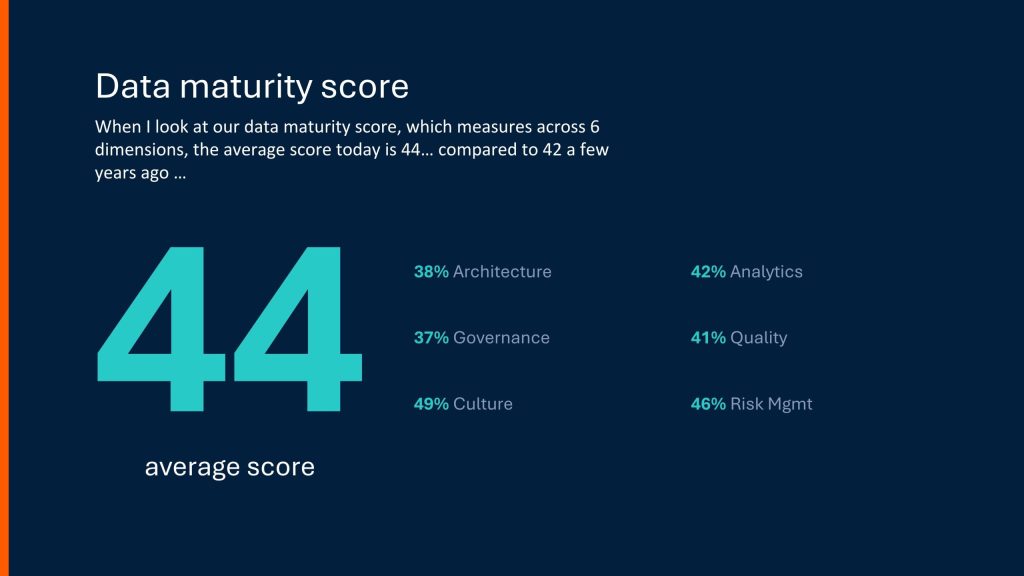
A few years ago, it was 42.
Culture scores highest at 49%. Governance scores lowest at 37%. Architecture sits at 38%. The rest hover in the low 40s.
These numbers reveal something uncomfortable: organizations are barely improving at the fundamentals.
AI readiness scores paint an even starker picture. The average sits at 17 out of 100.
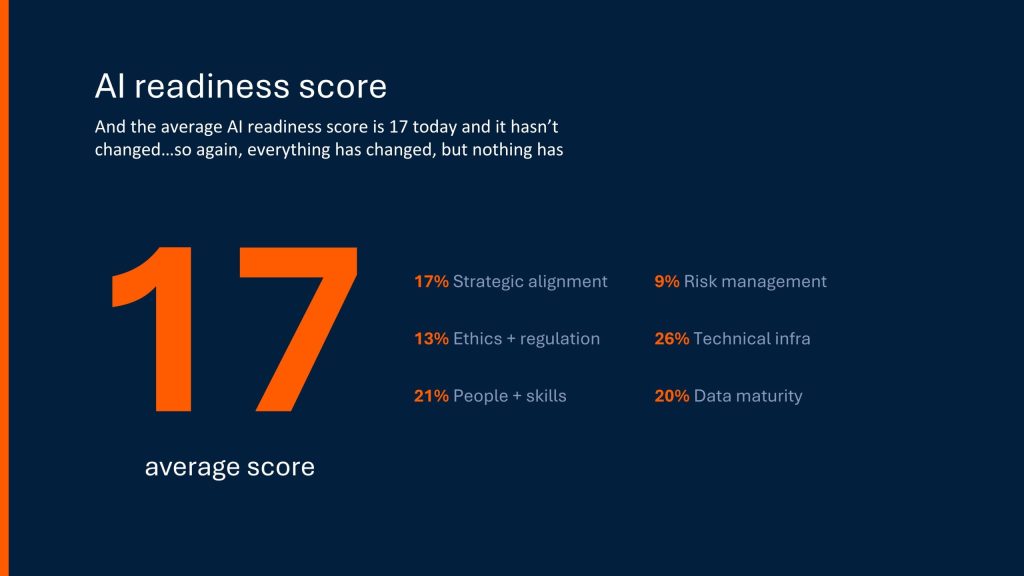
Risk management scores 9%. Strategic alignment hits 17%. Ethics and regulation land at 13%. Technical infrastructure performs best at 26%, but that’s still failing by any reasonable standard.
Organizations are rushing toward AI while standing on quicksand.
The Microsoft Shift
One thing did change: technology preferences.
In 2017, business leaders split fairly evenly between Microsoft, AWS, and GCP. We’re tech-agnostic, so we saw the full landscape.
Now, most leaders are doubling down on Microsoft.
The reason isn’t performance or capability. It’s perception.
Microsoft feels safe. Microsoft feels easier.
When leaders face uncertainty, they choose familiarity. The Microsoft ecosystem promises integration, support, and a single throat to choke when things go wrong.
This shift tells you more about organizational anxiety than it does about technology quality.
The AI Tool Split
For AI tools specifically, I see an even split between Copilot and Claude.
Copilot started rough. Leaders considered it poor in 2025.
Then Cowork in Copilot launched in 2026, and the quality jumped dramatically. The tool became genuinely useful.
This pattern repeats: the technology improves constantly, but adoption lags behind capability.
Most organizations still use AI for basic tasks. Summarize this document. Extract that information. Answer this question.
Very few organizations use AI to power end-to-end workflows. Even fewer embed AI into their products and services.
The gap between what AI can do and what organizations actually do with it keeps widening.
Dashboards Aren’t Dead, But They’re Fading
Leaders are starting to leverage AI-powered interrogation of data instead of static dashboards.
The dashboard served its purpose. It gave you visibility. It answered predetermined questions.
AI lets you ask the questions you didn’t know to ask.
This shift represents a fundamental change in how people interact with information. Instead of consuming what someone else decided was important, you explore what matters to you right now.
The organizations making this transition are moving faster and learning more.
The 50/50 Problem
We survey teams regularly about AI usage.
The split is consistent: 50% use AI, 50% don’t.
This isn’t a technology problem. You can give everyone access to the same tools, the same training, the same resources.
Half the team will use them. Half won’t.
This is the real challenge.
Technology is the easy part. Leaders are starting to recognize this truth.
The focus is shifting from tech-enablement to people-enablement. From training courses to year-long adoption programs. From rolling out tools to changing how people work.
You can’t train someone into using AI in a two-hour session. Adoption requires sustained support, clear use cases, and cultural permission to experiment and fail.
The Workforce Impact
Leaders worry about AI’s impact on their teams.
The pattern I see: reduced recruitment, not redundancies.
Organizations are choosing to do more with current headcount rather than cutting staff. When someone leaves, they’re not always replaced. The remaining team uses AI to absorb the work.
This approach avoids the morale hit of layoffs while still capturing efficiency gains.
It also creates a different kind of pressure. The people who stay need to adapt faster and learn continuously.
The Vague Opportunity
Every business leader I speak to sees huge opportunities in AI.
Ask them to define those opportunities, and the answers get vague. Unclear. Intangible.
This gap between sensing opportunity and defining it creates paralysis.
Organizations know they need to move. They don’t know where to move to.
The successful ones are picking a direction and moving. They’re running small experiments. They’re learning what works in their specific context rather than waiting for a perfect strategy to emerge.
The opportunity is huge. But only for the organizations willing to make it concrete.
What This Means for You
If your data maturity score sits in the low 40s, you’re not behind. You’re average.
That should terrify you.
Average means you’re facing the same problems you faced a decade ago. Average means your AI initiatives are built on a foundation that barely supports basic analytics.
The organizations pulling ahead are doing three things differently:
- First, they’re treating people-enablement as seriously as tech-enablement. They’re investing in long-term adoption programs, not quick training sessions. They’re creating space for experimentation and learning.
- Second, they’re moving from AI for Q&A to AI for workflows. They’re automating entire processes, not just individual tasks. They’re embedding AI into how work gets done, not bolting it onto existing processes.
- Third, they’re making the vague concrete. They’re defining specific use cases, measuring specific outcomes, and learning from specific experiments.
The technology will keep improving. The tools will keep getting better.
The question is whether your organization will improve alongside them, or whether you’ll still be fighting the same battles in 2035 that you fought in 2017.
The choice is yours. But the window for choosing is closing.
If your data maturity score has barely moved in years, what’s the honest reason it hasn’t, and what would it take to change that this year? Book a consultation with DATA³ and let’s find out.