

Your finance team spent three days last week reconciling numbers for a board presentation. Sales reported one revenue figure. Finance had another. Operations had a third.
By the time everyone agreed on which numbers were “right,” the conversation you needed to have—about what those numbers actually meant—never happened.
This isn’t a story about bad systems or lazy teams. It’s about an invisible tax that mid-market companies pay every single quarter, often without realizing the true cost until something breaks.
The Real Cost of Data Fragmentation
Data fragmentation sounds like a technical problem. It’s not.
When your departments operate on separate spreadsheets and systems that don’t communicate, you’re not just dealing with an IT headache. You’re bleeding competitive advantage.
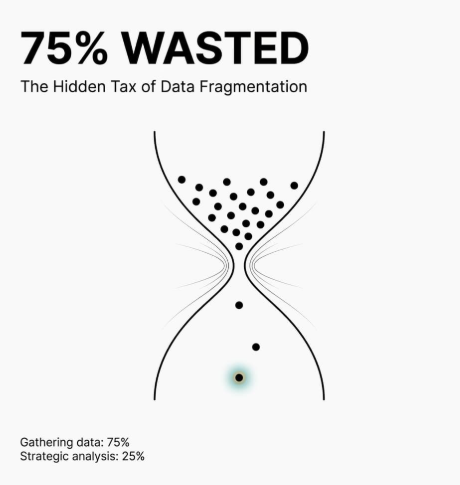
Consider the actual math: FP&A professionals spend only 25% of their time performing value-added analysis. The other 75%? Gathering data and administering processes.
Three-quarters of your finance leaders’ time goes to finding and reconciling information instead of analyzing what it means.
For a £50 million firm, even a 1% margin impact from delayed or poor decisions equals £500,000 annually. That’s the visible cost. The invisible cost runs deeper.
While your CFO spends days consolidating reports, your competitors with integrated systems are already acting on the insights you’re still trying to validate.
How Growth Creates Its Own Prison
Here’s the paradox: the functional growth that drives your revenue simultaneously creates the data silos that constrain your strategic agility.
You hired a great sales leader. They brought their CRM. Your operations director implemented their preferred inventory system. Finance standardized on their own planning tools.
Each decision made perfect sense in isolation.
But now you have professional services firms with client information trapped in siloed files. Manufacturers running separate production and finance systems that speak different languages. Department heads showing up to leadership meetings with conflicting versions of reality.
The systems that helped you scale to £50 million are the same systems preventing you from reaching £100 million.
As business complexity increases, these silos don’t just cause minor inconveniences. They create fundamental trust issues. When sales, operations, and finance each present different numbers for what should be the same metric, leaders stop trusting any of the data.
You end up making decisions based on instinct rather than insight because you can’t trust the information you’re receiving.
The Talent Gap That Turns Technical Problems Into Strategic Vulnerabilities
Even when mid-market leaders recognize data fragmentation as a problem, they face a compounding challenge: the talent who can fix it doesn’t exist in sufficient numbers.
IDC forecasts that by 2026, more than 90% of organizations will face IT skills shortages, costing an estimated $5.5 trillion in delays, quality issues, and lost revenue.
The shortage of data engineers and ERP consultants transforms what should be a solvable technical problem into a strategic vulnerability that persists for years.
You know what needs to happen. You have budget allocated. But you can’t find the people to execute.
This talent gap explains why 68% of medium-sized firms want better integrated tools yet remain stuck in a 12-36 month window of tolerating fragmentation. Recognition doesn’t lead to resolution when the resources to fix the problem are scarce.
Meanwhile, the hidden tax compounds quarter after quarter.

Why Smart Leaders Tolerate the Intolerable
The data reveals something uncomfortable: 46% of finance leaders lack full visibility into their company’s financial performance, and another 43% can’t make informed decisions because of data challenges.
That means nearly 9 in 10 CFOs operate with impaired insight.
Yet they tolerate it. Often for years.
The tolerance stems from a mental model that treats data fragmentation as an operational inconvenience rather than a strategic threat. It’s the problem you’ll fix “next quarter” when things slow down.
Except things never slow down.
Organizations average 897 applications but only 29% are integrated. The complexity feels overwhelming, so leaders default to acceptance rather than action.
The breaking point doesn’t come from gradual realization. It comes from crisis.
The Moments That Force Action
Companies eventually address data fragmentation, but almost never proactively. The triggers are reactive and often embarrassing:
A botched planning decision that leads to massive overstock or stockouts. A new CFO who demands better reporting and discovers the infrastructure doesn’t exist. Preparation for a sale or investment where due diligence exposes the lack of a single source of truth. A data scandal where wrong numbers get reported to the board.
These breaking points share a common thread: they’re all costly, public failures that could have been prevented.
The invisible tax suddenly becomes very visible when you’re explaining to potential acquirers why your departments can’t agree on basic metrics. Or when you’ve ordered £2 million in inventory based on incomplete data and now face a write-down.
The question isn’t whether you’ll address data fragmentation. It’s whether you’ll address it before or after a crisis forces your hand.
The Implementation Paradox
When companies finally commit to fixing data fragmentation through system upgrades or data warehouse projects, they face another uncomfortable reality: these initiatives take 12-18 months.
During that entire implementation period, you’re still operating with fragmented data. The hidden tax continues compounding.
Your competitors who started their integration journey earlier are now making faster, better-informed decisions while you’re still in the planning phase.
The timeline matters because markets don’t wait. When you need days to consolidate reporting, opportunities disappear before decisions get made. Disconnected systems reduce visibility across your value chain, causing stockouts, delivery delays, and lost revenue.
The cost of waiting isn’t just the efficiency you’re losing today. It’s the competitive ground you’re ceding to rivals who can operate faster.
Research consistently shows that organizations with connected, real-time data outperform competitors in operational efficiency, customer experience, and financial outcomes. The gap widens every quarter you tolerate fragmentation.

What Actually Resolves Fragmentation
Not all data initiatives succeed. In fact, 84% of system integration projects fail or partially fail.
The difference between companies that truly resolve fragmentation and those that just layer on another tool comes down to approach.
Companies that fail treat integration as a technical project. They buy a new dashboard or BI tool and expect it to magically unify their data. But the new tool just becomes another silo in the patchwork.
Companies that succeed treat integration as a strategic initiative. They start with a clear data strategy that defines what “single source of truth” actually means for their business. They invest in proper data architecture, not just front-end reporting. They allocate resources for data governance and quality management.
The solution isn’t another tool. It’s a fundamental rethinking of how data flows through your organization.
This requires executive commitment, cross-functional collaboration, and patience for medium-term results. It’s why many companies avoid it until crisis forces action.
The Competitive Reality
While you’re spending hundreds of FTE hours annually on manual data consolidation, your competitors with integrated architectures are spending those same hours on strategic analysis and innovation.
While your leadership team debates which department’s numbers are correct, competitors with unified data are already testing new strategies based on real-time insights.
While your finance leaders gather and reconcile data, their finance leaders are identifying opportunities and optimizing performance.
The hidden tax of data fragmentation isn’t just about internal inefficiency. It’s about the strategic agility you’re surrendering to competitors who solved this problem years ago.
Markets accelerate. Customer expectations evolve. Technology advances. And you’re still trying to agree on last quarter’s revenue.
The 12-36 month tolerance window that feels manageable today represents a critical competitive disadvantage in fast-moving markets. Every quarter you wait, the gap widens.

Moving From Recognition to Resolution
You already know data fragmentation is a problem. The 68% of mid-market firms seeking better integration aren’t lacking awareness.
What they’re lacking is urgency.
The invisible tax feels tolerable until it doesn’t. But by the time fragmentation forces a crisis, you’ve already paid years of compounding costs in lost efficiency, missed opportunities, and eroded competitive position.
The companies that win don’t wait for the breaking point. They recognize data fragmentation for what it actually is: not an IT problem, but a strategic imperative that directly impacts their ability to compete.
They treat data infrastructure with the same priority as product development or customer acquisition. Because in markets where speed and insight create advantage, unified data isn’t optional.
It’s the foundation that determines whether you’re building competitive advantage or just maintaining the status quo.
The question facing mid-market leaders isn’t whether to address data fragmentation. It’s whether you’ll address it proactively as a strategic investment, or reactively as crisis management after the hidden tax becomes impossible to ignore.
Your competitors are already making that choice. The ones pulling ahead chose proactive.