

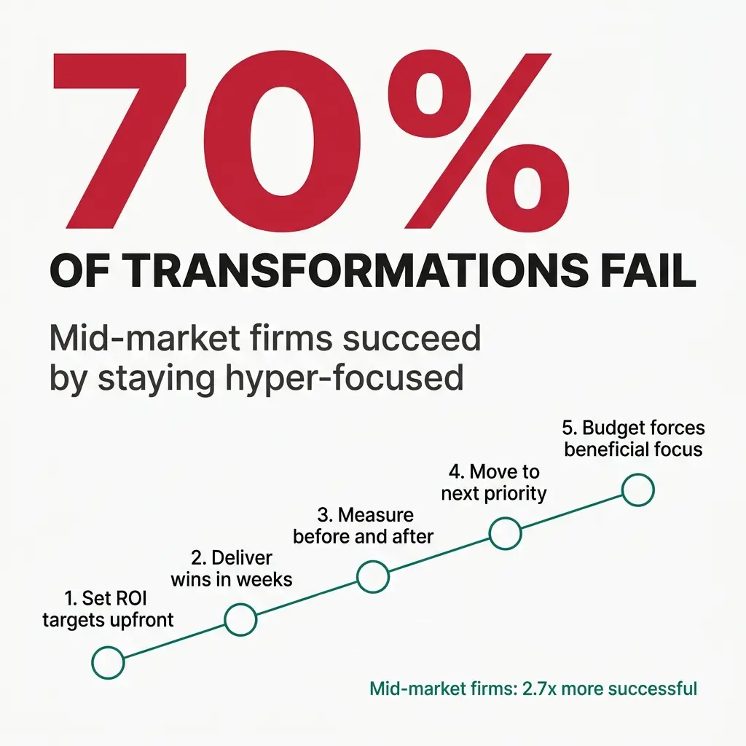
I’ve watched 70% of digital transformation projects fail. The pattern repeats itself: firms implement new technology, celebrate the launch, then quietly admit six months later that nothing fundamentally changed.
Mid-market firms face a different reality. You cannot afford failed experiments the way enterprises can absorb them.
The firms that succeed do something radically different from the start. They begin with a super-focused plan to solve priority problems and deliver value fast—in weeks, not months. ROI gets estimated upfront and used as a specific target, not just a number in a business case that everyone forgets.
The ROI Estimation That Actually Works
Here’s how successful mid-market firms set ROI targets before implementation begins.
They estimate the I (Investment) in terms of costs to implement solutions. They estimate the R (Return) in terms of cost savings, time savings, revenue increases, risk reduction, and more. This gives them the ROI that can be achieved—before they’ve spent a penny.
But estimation means nothing without tracking.
You need to track delivery against time, cost, and quality to ensure the Investment side gets delivered as planned. Only 35% of organisations effectively measure ROI from digital transformation initiatives. Nearly 29% struggle with establishing data-driven ROI metrics.
The Return side proves harder to measure. It’s hard because you need to make assumptions. What does this help us do differently or faster? How many hours per week does this save? How many more products can we sell? Does this reduce the number of customers we’ll lose?
Make it specific and add numbers to it.
Measuring Before and After
One firm measured processes before and after implementation. They sped processes up to increase throughput by 10-fold.
Ten-fold improvements don’t happen by accident. They happen because firms map out processes first, identify what can be automated versus what needs to keep a human in the loop, then automate the part that benefits the most.
The customer-facing part remained human, as expected. But the back-office processes that slowed everything down got automated systematically.
This validates what research shows: organisations automate broken processes and wonder why problems persist. Technology doesn’t fix what isn’t understood. It only accelerates what already exists.
Companies that focus on measurable outcomes like productivity, customer satisfaction, and process efficiency are twice as likely to achieve ROI success.
Quick Wins in Weeks, Not Months
After achieving that first quick win—like the 10-fold throughput increase—successful firms move to the next priority problem. They keep going down the list.
They deliver value again and again in really specific places. Not in a vague way. In a hyper-focused, specific, problem-solving way.
This approach differs fundamentally from typical “enterprise-wide digital transformation” strategies. Research proves it: smaller businesses (with 100 or fewer employees) are 2.7 times more successful in digital transformation efforts than enterprises with over 50,000 employees.
Why? Sometimes it’s better to have a small budget because that forces you to focus. It forces you to be specific. Larger organisations can spend much more time navel-gazing and wasting time because they can afford it.
Mid-market and small firms focus really specifically. They’re much more nimble and focused on ROI to ensure they don’t waste any money.
The Discipline That Separates Success From Failure
Budget constraints become strategic advantages when they force beneficial focus. The data proves it: companies that align digital change capabilities with strategy and tech investments receive a 14% market-cap premium over peers that treat transformation as a bolt-on project.
The discipline of resource scarcity prevents waste. It creates what I call hyper-focused, problem-solving transformation.
With global digital transformation spending projected to hit £3.4 trillion by 2026, many companies still struggle to see returns. In a June 2023 survey, 41% of firms saw higher ROI within just 2 years of adopting digital transformation. That means 59% didn’t.
The answer to transformation failure often lies not in the technologies themselves, but in execution and adoption. A Gartner survey found that only 48% of digital transformation projects succeed, with common reasons for failure including lack of commitment, poor pilot design, resistance to change, and most importantly, a lack of digital value creation-driven metrics.
What This Means For Your Transformation
Start with priority problems, not comprehensive strategies. Estimate ROI upfront as a specific target you’ll hit. Deliver value in weeks to build momentum.
Map your processes before deploying technology. Identify what to automate and what needs humans. Measure before and after to validate your assumptions.
Move to the next priority problem once you’ve delivered the first win. Keep the focus hyper-specific. Let your budget constraints force the discipline that larger organisations struggle to maintain.
The firms that succeed treat digital transformation as a series of focused problem-solving exercises, each delivering measurable value. They don’t transform everything at once. They transform specific things, prove the value, then move to the next priority.
That’s how mid-market firms deliver real change, tangible business improvements, and ROI that you can actually measure.