

Every CFO knows the numbers don’t add up. Every operations manager sees the bottlenecks. Every HR leader watches talented people walk out the door.
Yet the Excel spreadsheets remain. The paper approvals pile up. The manual processes grind on.
We’ve spent years investigating why mid-market companies stay trapped in operational inefficiency despite knowing better. The answer isn’t what most people think.
The Real Cost Nobody Calculates
When you look at a P&L statement, operational inefficiency doesn’t show up as a single line item. It’s hidden everywhere.
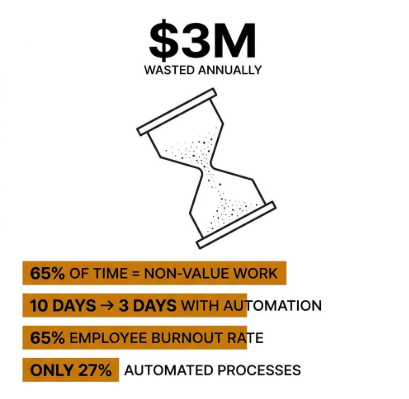
McKinsey research reveals that 20-30% of operating expenses are wasted on inefficiency across industries. For a $10 million business, that’s $2-3 million burned annually on activities that don’t create value.
But the financial drain tells only part of the story.
The average employee spends 60-65% of their week on work that doesn’t create new value. That’s nearly 3 out of every 5 days lost to inefficiency. More than half of employees spend at least two hours daily on repetitive tasks, while 60% of workforce time goes to “work about work” rather than skilled work.
Consider what this looks like on a Tuesday afternoon in your finance department.
An AP team member manually processes invoices—only 5 to 10 per hour. A company receiving 1,000 monthly invoices dedicates 100-200 hours to data entry alone, before approvals, exceptions, or reconciliation work even begins. Research shows it takes 10.1 days to process an invoice manually, compared to 3.4 days with automation.
Meanwhile, your operations manager re-enters the same data from one system to another. Your HR team manually tracks time on paper forms that 80% of employers must correct due to errors. Your finance analyst spends 5+ hours weekly chasing late payments.
This isn’t efficiency. It’s organizational quicksand.
When Workarounds Become the Operating System
Here’s what we’ve observed across dozens of mid-market companies: employees know the official process is broken, so they create shortcuts.
These workarounds start innocently. Someone finds a faster way to get an approval. Another person builds a personal spreadsheet to track what the system should track automatically. A third creates an email-based process because the formal workflow takes too long.
Then growth happens.
Transaction volumes increase. The workarounds that functioned for 50 transactions per month collapse under 500. The personal spreadsheet becomes mission-critical infrastructure that only one person understands. The email-based approval process creates bottlenecks that delay customer deliveries.
The informal system becomes more important than the formal one. And nobody documented it.
We’ve seen this pattern repeat across sectors. In manufacturing, it’s manual scheduling and paperwork. In professional services, it’s manual report preparation. In finance operations, it’s data re-entry and reconciliation.
The business consequences compound quickly: higher operating expenses, slower market response, difficulty scaling without linear headcount increases, and employee frustration that drives turnover.
The Talent Retention Crisis Nobody Connects
Mid-market companies face a talent problem they don’t fully recognize.
When a talented operations manager or finance analyst leaves because they’re tired of manually chasing approvals and re-entering data, most organizations calculate only the replacement cost. They miss the strategic vulnerability.
The data tells a stark story. A 2023 report found that 65% of American workers felt burned out, and 72% believe burnout impacted their productivity. The under-challenged subtype of burnout is typical of monotonous and unstimulating professions, with repetitive, mechanical, and routine tasks that don’t provide necessary satisfaction.
Nearly half of HR leaders say employee burnout is responsible for up to half of their annual workforce turnover. Insufficient technology for employees to do their jobs was identified by 20% of HR leaders as a primary cause of burnout.
Research shows that chronic boredom from repetitive work has the same effects as burnout: increased turnover, early retirement intentions, poor self-rated health, and stress symptoms. A Korn Ferry survey found that boredom is the top reason why people leave their jobs.
Your competitors understand this. One tech company that implemented AI to redistribute workload and streamline processes reported a 20% reduction in employee turnover within one year.
The connection is clear. Operational inefficiency doesn’t just waste time. It drives your best people away.

The Mid-Market Automation Gap
Here’s the paradox: mid-market companies have the most to gain from process modernization, yet they lag behind both enterprises and agile startups.
The numbers reveal the gap. Despite 89% of finance leaders racing to automate, only 27% of finance departments have automated more than half their processes. Just 2% are fully automated.
This gap between intention and execution represents massive untapped opportunity.
In organizations with mostly manual, paper-based workflows, 3 in 5 respondents said their biggest struggle with implementing automation was a desire to stick to the status quo. Psychology, not technology, is often the real barrier.
We’ve identified several systemic reasons for this trap:
Cost perception vs. reality. Many firms view automation as expensive, yet they’re already spending more. If 20% of employee time in a 500-person firm is spent on low-value manual work that could be streamlined, that’s equivalent to 100 FTEs of waste—over $4 million annually.
The growth paradox. Companies say they focused on growth instead of investing in automation. But growth is exactly when you need operational efficiency most. As transaction volumes increase, manual processes become unsustainable.
Staff shortage reality. There are fewer clerks to throw at the problem. The traditional solution of adding headcount no longer works in tight labor markets.
Legacy system inertia. More than half of employees said dated business processes prevent them from doing their jobs properly, while 48% believed better workplace technology would improve their productivity.
The Sector-Specific Manifestation
Operational inefficiency doesn’t look the same everywhere. We’ve tracked how it manifests across different sectors.
Professional services face particularly acute challenges. At mid-sized law firms, the average fee-earner is only 50-63% billable. The rest is admin and non-chargeable work. Think about that: highly paid professionals spending nearly half their time on process overhead rather than client work.
95% of medium law firms say fee-earner time pressure is a top compliance challenge. These aren’t hidden problems. Every managing partner knows their utilization rates.
Manufacturing struggles with manual scheduling and paperwork that compounds as production volumes increase. Companies with fragmented systems experience 20% longer cycles on average.
Service businesses spend enormous time on manual report preparation. Recent statistics show that 38% of American employees still use manual systems like punch cards and paper timesheets.
The common thread: processes that grew “organically” without intentional design. They worked fine at smaller scale. Growth exposed their fragility.

When Competitors Pull Ahead
The competitive dynamics shift faster than most mid-market leaders realize.
When a competitor automates their invoice processing, they don’t just save time. They gain multiple advantages simultaneously: faster cash conversion, lower operating costs, ability to scale without proportional headcount increases, and improved customer experience through faster response times.
Deloitte found that organizations implementing automation typically reduce operating expenses by 25-40%. Manual processing error rates average 2-5% compared to automated systems achieving 99.9% accuracy.
The gap compounds quickly. Your competitor can now respond to customer requests in hours instead of days. They can take on 50% more volume without adding staff. They can offer better pricing because their cost structure improved.
Meanwhile, you’re still manually processing paperwork.
Organizations that had comprehensive operational transparency could respond quickly to disruptions, while those without suffered inefficiencies and cost overruns. The conditions that masked inefficiencies in recent years—such as strong post-pandemic pricing power—have diminished, exposing margin pressures and operational weaknesses.
Economic pressure now forces a closer look at internal inefficiencies that were tolerated during high growth periods.
The Breaking Point
We’ve studied what finally triggers change in mid-market companies. The pattern is remarkably consistent.
Sudden growth spurts that make current processes unsustainable. A company wins a major contract that doubles transaction volume overnight. The manual workflows that barely functioned before completely collapse.
Errors with consequences. A compliance miss due to manual mistakes triggers regulatory scrutiny. A major customer delivery fails because approvals got lost in email chains. The cost of one error suddenly exceeds the cost of fixing the system.
Competitive wake-up calls. A competitor’s success story prompts reconsideration. When you see a peer company handling twice your volume with the same headcount, the math becomes impossible to ignore.
Investor pressure. Private equity or board members demand margin improvements. They ask why operating expenses are 30% higher than industry benchmarks. The CFO finally has the mandate to act.
The tragedy is that these breaking points are predictable. Without intentional process improvement, inefficiencies persist and compound as the company grows. Most firms continue with the status quo until crisis forces change.
The timeline is typically 12-36 months from recognizing the problem to addressing it. That’s 1-3 years of continued waste while the organization debates action.

The Path Forward
The solution isn’t a massive technology overhaul that paralyzes decision-making.
We’ve seen successful transformations follow a different pattern. They start with one high-pain process and prove value quickly.
Pick your highest-volume bottleneck. For most mid-market companies, that’s invoice processing, expense approvals, or time tracking. These processes touch many people, have clear metrics, and deliver fast ROI.
Organizations implementing AP automation report an 83% reduction in invoice processing time, 90% fewer manual data entry errors, and 5-7 business days faster month-end close. Many see returns of 300-500% within the first year.
Target 12-18 month payback. A Forrester study found one AP automation platform delivered 158% ROI over three years, with payback in under six months. Teams reported a 50% productivity boost by eliminating manual data entry and approval follow-ups.
Start where pain is highest and volume is predictable. One global company increased invoice volume by 50% without adding headcount thanks to advanced workflows. A mid-market manufacturing company spent $60,000 on accounts payable automation, cutting processing time by 75% and eliminating two full-time roles within six months.
Redeploy saved capacity to higher-value work. The goal isn’t just cost reduction. It’s freeing your talented people from repetitive tasks so they can focus on strategic activities that actually grow the business.
Cycle time improvements translate directly to faster cash conversion and sales. Reducing a process from 5 days to 1 day doesn’t just save time. It improves working capital and customer satisfaction simultaneously.
The Real Question
Every mid-market leader faces a choice.
You can continue tolerating operational inefficiency while your competitors modernize. You can keep losing talented people to boring, repetitive work. You can watch your cost structure become increasingly uncompetitive.
Or you can acknowledge that the “hidden tax” on growth is real, quantifiable, and solvable.
The technology exists. The ROI is proven. The competitive pressure is mounting.
What’s actually keeping you stuck? Certainly not data or AI.