
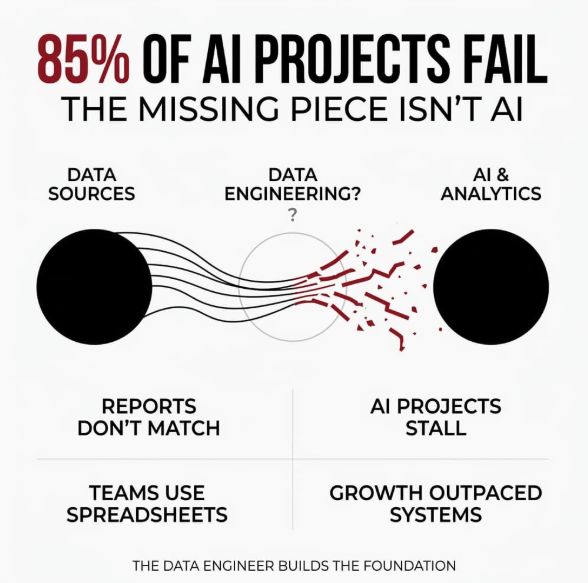
Here’s what we’re seeing: companies are rushing to hire data scientists and AI specialists while their AI projects are failing at an alarming rate. Research shows 70-85% of AI initiatives never make it to production, and the culprit isn’t bad algorithms. It’s bad data.
The missing piece? A data engineer.
Most business leaders don’t wake up thinking they need a data engineer. They notice their reports don’t match, their teams spend 20 hours a week wrestling with Excel, or their shiny new AI project stalls because the data is a mess. By then, the problem has been quietly sabotaging their growth for months.
In this article, we’ll cover what a data engineer actually does, how they differ from data scientists and analysts, when your business needs one, and whether to hire in-house or outsource. We’ll also address how AI is changing the role and what that means for your hiring decisions.
What is a data engineer, in plain English?
A data engineer designs and builds systems for collecting, storing, and analyzing data at scale. They integrate, transform, and consolidate data from various structured and unstructured sources into formats suitable for analytics and AI.
Think of them as the architects and builders of your data infrastructure. While data scientists analyze data to predict trends, data engineers create the reliable pipelines that make that analysis possible in the first place.
What does a data engineer actually do for a business?
Here’s the reality: data engineers are problem-solvers who live and breathe data. They extract, ingest, cleanse, combine, model, and wrangle data that’s often disconnected, messy, or buried in systems that don’t talk to each other.
But great data engineers do something most people overlook. They work with non-technical stakeholders to understand business problems, identify root causes, design solutions, and then translate those solutions back into language business leaders can understand.
This translation skill is rare. Most people are either technical (speaking in jargon-filled language) or non-technical (speaking the language of business). Great data engineers bridge that gap.
Connecting disconnected data sources
Your customer data lives in your CRM. Your sales data sits in one system. Your financial data is in another. Your operational metrics are scattered across spreadsheets.
Data engineers connect these disconnected sources. They set up data platforms—including data warehouses, lakehouses, databases, and ETL (extract, transform, load) tools—that bring everything together in one place.
Without this connection, your teams are making decisions based on incomplete pictures of reality.
Building reliable data pipelines
A data pipeline is the automated flow of data from source systems to where it’s needed for analysis or reporting. Data engineers build these pipelines to be high-performing, efficient, organized, and reliable.
They write ETL scripts and code to ensure data moves optimally. They re-engineer manual data flows to enable scaling and repeatable use. They build data streaming systems that handle real-time information.
The result? Answers in days instead of months, through exploratory analysis and rapid iteration.
Creating trustworthy foundations for reporting and AI
Here’s the uncomfortable truth: poor data quality costs organizations an average of $12.9-$15 million annually. For large companies, that number jumps to $406 million per year.
Data engineers combine, cleanse, and run health checks on data. They transfer and store it securely in line with industry best practices and regulatory requirements. They refine and ensure accuracy of data interfaces provided by third parties.
This trustworthy foundation is what makes reporting reliable and AI initiatives possible. Without it, you’re building on sand.
Reducing manual data work across teams
Employees spend 50-80% of their time on data wrangling and “data janitor work” before they can even begin analysis. That’s time your team could spend generating value instead of hunting for the right spreadsheet or reconciling conflicting numbers.
Data engineers document source-to-target mappings, develop reusable business intelligence reports, and build accessible data for analysis. They share knowledge with the wider team so everyone can work more efficiently.
The productivity gain alone often justifies the investment.

Reducing manual data work across teams
Employees spend 50-80% of their time on data wrangling and “data janitor work” before they can even begin analysis. That’s time your team could spend generating value instead of hunting for the right spreadsheet or reconciling conflicting numbers.
Data engineers document source-to-target mappings, develop reusable business intelligence reports, and build accessible data for analysis. They share knowledge with the wider team so everyone can work more efficiently.
The productivity gain alone often justifies the investment.
Data engineer vs data scientist vs analyst
These roles are complementary, not interchangeable. Understanding the distinction matters when you’re deciding who to hire.
Data engineers build and maintain the systems that store, extract, and organize data. They deal with raw data that contains human, machine, or instrument errors. They create the infrastructure that makes data accessible and reliable.
Data scientists analyze that data to predict trends and glean business insights. They build models, run experiments, and answer complex business questions using statistical methods and machine learning.
Data analysts focus on interpreting data to support day-to-day business decisions. They create reports, dashboards, and visualizations that help teams understand what’s happening and why.
Here’s the critical point: without data engineers to build strong and reliable architecture, data scientists can’t efficiently analyze data. Only 1 in 10 data science projects make it to production, and projects often get delayed or dropped when teams run out of time and money dealing with cumbersome datasets.
You need balance. Business subject matter expertise (people who know your commercial model, customers, and how you make money) plus technical capability to design and build solutions. Data engineers are the latter, but great ones want to understand the business side too.
When does a business need data engineering?
Companies don’t usually realize they have a data engineering problem until specific symptoms appear. Here are the warning signs that you’ve outgrown your current data infrastructure.
Reporting takes too long or isn’t trusted
When the finance team’s numbers don’t match the sales team’s numbers, someone’s credibility is on the line. This is politically loaded, and it’s more common than most executives want to admit.
If your teams are arguing about which data is “right,” or if pulling a simple report takes days instead of hours, you have a data engineering problem.
Data engineers navigate these situations by integrating and consolidating data from various sources into one reliable version of the truth. They create data pipelines and stores that are organized and trustworthy, given your specific business requirements and constraints.
AI initiatives are blocked by poor data quality
This is the invisible crisis. 81% of AI professionals say their company has significant data quality issues, yet 85% believe leadership isn’t addressing these problems.
The shocking reality: companies invest in AI tools first and think about data quality later. They waste time and money because their AI ambitions are built on unreliable foundations.
Fields like machine learning and deep learning can’t succeed without data engineers to process and channel that data. In a world producing 463 exabytes of data per day by 2025, you need people who can make that data usable.
Teams rely heavily on spreadsheets
Spreadsheets are useful tools, but when they become your primary data infrastructure, you’re in trouble. Manual processes don’t scale. They’re error-prone, time-consuming, and impossible to audit properly.
If your teams are emailing Excel files back and forth, copying and pasting data between systems, or maintaining complex spreadsheet models that only one person understands, you need data engineering.
Data engineers implement data flows to connect operational systems with analytics and business intelligence systems. They re-engineer manual data flows to enable scaling and repeatable use.
Growth has outpaced systems
The systems that worked when you had 10 employees and 100 customers don’t work when you have 50 employees and 10,000 customers. Growth exposes the cracks in your data infrastructure.
Maybe your reports are slower than they used to be. Maybe you’re adding new products or services and can’t easily track performance across everything. Maybe you’re expanding into new markets and need to consolidate data from multiple regions.
These are signs that your business has outgrown its current setup. Data engineers design and support data pipelines that can handle your current scale and grow with you.

Should you hire a data engineer or outsource?
This decision depends on your specific constraints and requirements. There’s no one-size-fits-all answer, but here’s the honest conversation about each approach.
In-house pros and cons
Pros:
- Deep understanding of your business over time
- Full availability and dedication to your priorities
- Direct integration with your team culture
- Long-term institutional knowledge
- Ability to iterate quickly on internal projects
Cons:
- High cost (salary, benefits, equipment, training)
- Long ramp-up time to learn your business
- Recruitment challenges in a competitive market
- Risk if the person leaves
- May lack exposure to diverse problems and solutions
Hiring in-house makes sense when you have consistent, ongoing data engineering needs and the budget to support a full-time role. It works best for companies with sufficient scale to keep a data engineer busy and engaged.
Outsourcing pros and cons
Pros:
- Immediate access to experienced professionals
- Exposure to best practices from multiple industries
- Flexibility to scale up or down as needed
- Lower risk if the engagement doesn’t work out
- Faster time to value on initial projects
Cons:
- Less institutional knowledge about your business
- Potential communication overhead
- Divided attention across multiple clients
- Dependency on external partner
- May be more expensive per hour (though not necessarily overall)
Outsourcing works well for companies that need expertise quickly, have project-based needs, or want to test the value of data engineering before committing to a full-time hire.
Hybrid models (consultancy-led foundations and internal ownership)
Many companies find success with a hybrid approach. External consultants build the initial foundation and establish best practices. Then an internal team maintains and evolves the system.
This model combines the speed and expertise of outsourcing with the long-term benefits of internal ownership. The consultancy sets up your data platforms, implements initial data flows, and trains your team. Your internal people then handle day-to-day operations and incremental improvements.
The key is clarity about ownership and transition. Up to 75% of governance initiatives fail because ownership is unclear. Define roles, responsibilities, and handoff criteria upfront.
For a 50-person company hitting the warning signs we discussed, a hybrid model often provides the best balance. You get expert guidance on architecture decisions while building internal capability for the long term.

How AI is changing the role of the data engineer
There’s a lot of hype about AI replacing jobs. The reality for data engineers is more nuanced.
AI tools are emerging for automated data cleaning, AI-assisted pipeline building, and even AI that writes SQL. These tools are making data engineers more productive, not obsolete.
According to a 2024 survey, 83% of data engineers said AI and new tools made them more productive. But here’s the catch: over 95% feel they’re at or over their work limit, with 24% heavily overloaded.
AI is reshaping the role by automating routine tasks. Data engineers can focus more on strategic architecture decisions, complex problem-solving, and that critical translation work between technical and business teams.
What companies get wrong is assuming AI tools can replace the need for a data engineer. The tools still require someone who understands data architecture, business requirements, and how to implement solutions that scale.
The market confirms this. Data engineering has seen 50% year-over-year job growth, making it one of the fastest-growing occupations in tech. The field now employs over 150,000 professionals globally.
Companies are creating data engineering positions faster than qualified candidates are entering the field. The talent shortage is real, which is why compensation packages are competitive and remote work opportunities are increasing.
AI isn’t eliminating the need for data engineers. It’s increasing it by making data infrastructure even more critical to business success.
Conclusion
If your reports don’t match, your AI projects are stalling, or your teams are drowning in spreadsheets, you don’t have a software problem. You have a data engineering problem.
The question isn’t whether you need data engineering. It’s how you’re going to get it—and how quickly you can build that foundation before your next growth phase or AI initiative.
We help businesses build reliable data infrastructure that supports reporting, analytics, and AI. If you’re ready to move from chaos to clarity, let’s talk about what data engineering can do for your business.