

Helen Tanner is Founder and CEO of DATA³ and spends much of her time talking to leaders about where their AI efforts are actually working, and where they’ve quietly stalled. In this piece, Helen breaks down why most AI strategies fail: not because businesses pick the wrong tools, but because they only ever build one-third of the strategy they need.
You’re probably approaching AI wrong.
Not because you lack vision or resources. But because you’re treating AI as a single problem when it’s actually three completely different challenges that need three separate strategies.
Most business leaders I talk with focus on one dimension of AI and ignore the other two. Some invest heavily in automation tools but leave their teams confused and resistant. Others train their people extensively but never actually deploy AI where it matters. A few build impressive AI-powered products while their internal operations remain stuck in 2015.
The result? Fragmented efforts. Wasted budget. Competitive disadvantage.
Here’s what actually works: a three-pillar approach that addresses AI for people-enablement, AI for automation, and AI for client-facing services. Each pillar requires different thinking, different investment, and different execution.
Let me break down what each one means for your business.
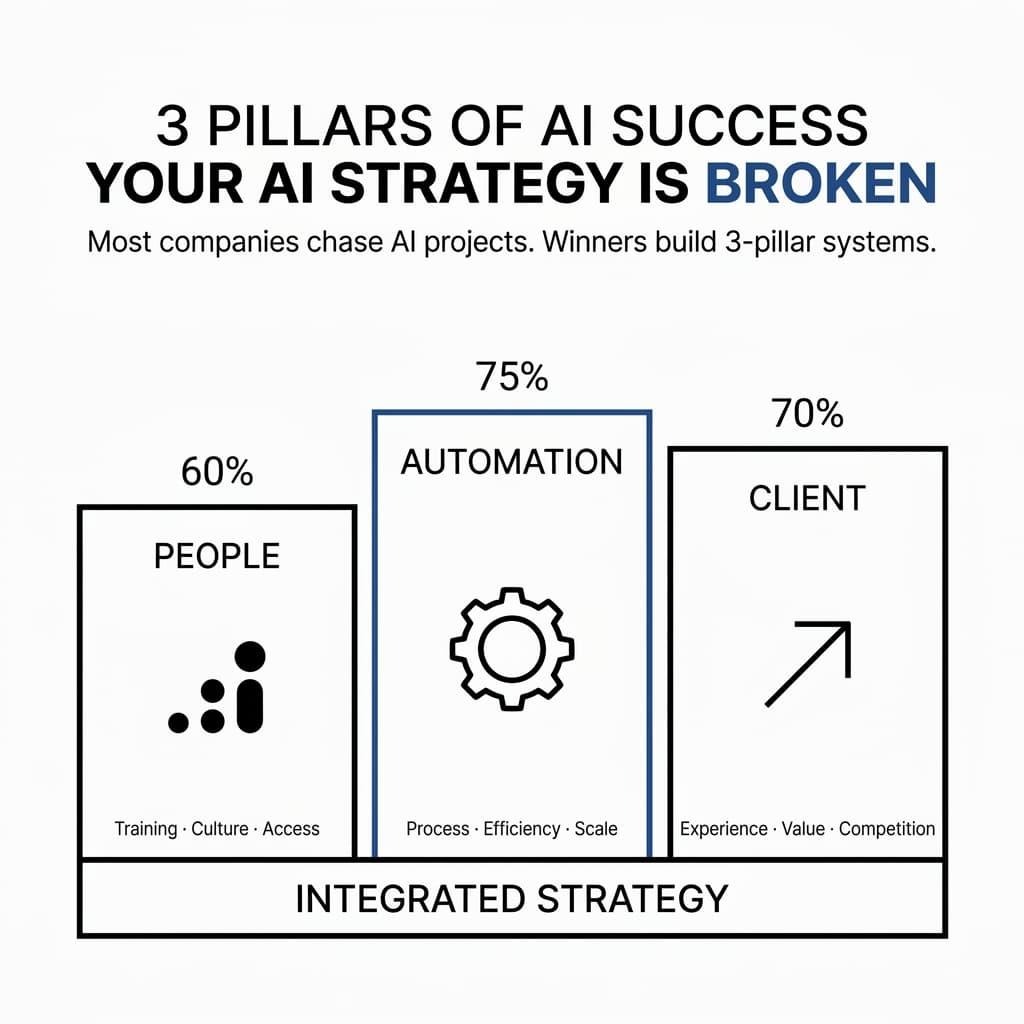
Pillar One: AI for People-Enablement
This is where most AI strategies fail before they even start.
You can’t bolt AI onto an unprepared workforce and expect magic. Your teams need the right tools, clear policies, proper training, practical guidance, and a culture that supports experimentation without fear.
People-enablement isn’t about teaching everyone to code. It’s about removing the barriers between your team and the AI tools that make them more effective.
Start with access. Which AI tools does your team actually need? ChatGPT for research and writing? Midjourney for visual concepts? Claude for analysis? GitHub Copilot for development? You need to decide what’s available, what’s approved, and what’s off-limits.
Then comes policy. Your people need clear answers to basic questions:
- Can I use AI for client work?
- What data can I feed into these tools?
- Do I need to disclose when I use AI?
- What happens if the AI produces something wrong or biased?
- How do we handle intellectual property and copyright?
Without clear policies, your team operates in a gray zone. Some people use AI aggressively and take risks you didn’t approve. Others avoid it completely because they’re afraid of crossing an invisible line.
Training matters, but not the way you think.
Skip the theoretical workshops about how neural networks function. Your marketing manager doesn’t need to understand transformer architecture. She needs to know how to use AI to analyze campaign performance, generate content variations, and identify audience segments.
Focus on practical, role-specific training. Show your sales team how to use AI for prospect research and email personalization. Teach your finance team how to automate reporting and forecast modeling. Give your customer service reps AI tools that surface relevant knowledge base articles instantly.
The McKinsey State of AI report found that organizations with comprehensive AI training programs see adoption rates three times higher than those without structured learning paths.
But training alone isn’t enough. You need to build a culture where AI experimentation is encouraged, not punished.
When someone tries an AI tool and it produces a mediocre result, do they get criticized for wasting time? Or do they get credit for exploring new approaches? Your answer to that question determines whether your team actually adopts AI or just nods along in meetings while doing things the old way.
Pillar Two: AI for Automation
This is where AI delivers immediate ROI.
You have manual processes eating up hours every week. Data entry. Report generation. Email sorting. Schedule coordination. Invoice processing. Expense categorization. Customer inquiry routing.
These tasks don’t require human creativity or judgment. They require consistency, speed, and accuracy. That’s where AI excels.
Start by mapping your most time-consuming manual processes. Ask your team: “What tasks do you do every week that feel like busywork?” You’ll get a list of automation candidates immediately.
Then prioritize based on two factors: volume and complexity.
High-volume, low-complexity tasks are your quick wins. Automating email responses to common customer questions. Extracting data from invoices. Categorizing support tickets. Scheduling social media posts. These implementations take weeks, not months, and the time savings are obvious.
But here’s where it gets interesting: AI lets you automate things that weren’t automatable before.
Traditional automation required rigid rules and structured data. AI handles ambiguity, context, and unstructured information. You can now automate tasks that involve reading, understanding, and responding to natural language.
Consider what this means for your business:
- Automatically summarizing customer feedback from surveys, emails, and chat logs
- Analyzing contract documents to flag unusual terms or missing clauses
- Monitoring competitor websites and alerting you to pricing changes or new products
- Generating first-draft responses to RFPs based on your previous proposals
- Enriching your CRM data by researching prospects and adding relevant context
These aren’t simple “if-this-then-that” automations. They’re intelligent processes that augment your team’s capabilities.
According to Gartner research, more than 80 percent of enterprises will have deployed generative AI-enabled applications by 2026, primarily for operational efficiency.
The key is to start small and scale what works. Pick one process, automate it, measure the impact, and then move to the next. Don’t try to automate everything at once.
And remember: automation isn’t about eliminating jobs. It’s about eliminating the tedious parts of jobs so your team can focus on work that actually requires human insight, creativity, and relationship-building.
Pillar Three: AI for Client-Facing Services
This is where AI becomes a competitive differentiator.
Your clients expect more personalization, faster responses, and smarter solutions. AI lets you deliver all three at a scale that was impossible five years ago.
The question isn’t whether to integrate AI into your products and services. The question is how fast you can do it before your competitors do.
Start by examining your current client experience. Where do people get frustrated? Where do they wait? Where do they settle for generic solutions because personalized ones are too expensive or time-consuming?
Those friction points are your opportunities.
If you’re in professional services, AI can help you deliver faster insights. A consulting firm can use AI to analyze a client’s data and generate preliminary recommendations before the first meeting. A law firm can use AI to review contracts and flag potential issues in minutes instead of hours.
If you’re in e-commerce, AI can personalize product recommendations based on browsing behavior, purchase history, and similar customer patterns. You can generate product descriptions optimized for different customer segments. You can provide instant, intelligent customer support through AI-powered chat.
If you’re in B2B software, AI can power features your customers didn’t know they needed. Predictive analytics that forecast trends before they happen. Automated insights that surface hidden patterns in their data. Smart assistants that guide users through complex workflows.
But here’s the critical part: your AI-powered offerings need to solve real problems, not just showcase technology.
Nobody cares that you use AI. They care about outcomes. Faster results. Better accuracy. More personalization. Lower costs. Easier workflows.
Frame your AI features around client benefits, not technical capabilities. Don’t say “powered by advanced machine learning algorithms.” Say “get answers in seconds instead of days.”
And be transparent about what AI does and doesn’t do. If your AI tool requires human review, say so. If it works best for certain types of problems, explain that. If it has limitations, acknowledge them.
Trust matters more than hype.
Why You Need All Three Pillars
Here’s what happens when you focus on only one or two pillars:
- People-enablement without automation or client services: Your team learns about AI and gets excited, but nothing actually changes. They attend workshops, experiment with tools, and then go back to their regular work because there’s no systematic integration.
- Automation without people-enablement or client services: You implement AI tools that your team resists or misuses because they don’t understand the purpose or feel threatened by the change. Your automation projects stall because of cultural resistance.
- Client-facing AI without people-enablement or automation: You build impressive AI features for customers while your internal operations remain inefficient. Your team struggles to support these AI products because they lack the training and tools to do so effectively.
Each pillar reinforces the others.
When you enable your people with AI skills and tools, they identify better automation opportunities and contribute ideas for client-facing features. When you automate internal processes, you free up resources to invest in training and product development. When you deliver AI-powered client services, you learn lessons that inform your internal automation strategy.
This is how organizational transformation actually works. Not through a single initiative, but through coordinated progress across multiple dimensions.
Building Your Three-Pillar AI Strategy
You don’t need to tackle all three pillars simultaneously. But you do need a plan for all three.
Start by assessing where you are today:
People-Enablement Assessment:
- Do your teams have access to AI tools relevant to their work?
- Do you have clear policies about AI use?
- Have you provided practical, role-specific AI training?
- Does your culture encourage AI experimentation?
Automation Assessment:
- Have you mapped your most time-consuming manual processes?
- Have you identified quick-win automation opportunities?
- Are you exploring AI automation for tasks that weren’t automatable before?
- Do you have a system for measuring automation impact?
Client-Facing Assessment:
- Have you identified friction points in your client experience?
- Are you exploring AI features that solve real client problems?
- Can you articulate the client benefits of your AI initiatives?
- Do you have a plan for transparent, trustworthy AI deployment?
Based on your assessment, prioritize your next moves. Maybe you need to start with people-enablement to build the foundation. Maybe you have quick automation wins that will fund further investment. Maybe you have a competitive threat that requires fast action on client-facing AI.
The sequence matters less than the commitment to address all three pillars.
Set clear goals for each pillar. Not vague aspirations like “become AI-driven,” but specific, measurable outcomes:
- Train 80% of team members on role-specific AI tools by Q2
- Automate five high-volume manual processes by Q3
- Launch two AI-powered client features by Q4
Assign ownership. Who’s responsible for people-enablement? Who’s driving automation initiatives? Who’s leading client-facing AI development? These can’t be side projects that nobody owns.
Allocate budget across all three pillars. If you spend 90% of your AI budget on automation and nothing on training or product development, you’re building an unbalanced strategy that will underperform.
And build feedback loops. What are you learning from your people-enablement efforts? How are those lessons informing your automation priorities? What are clients telling you about your AI features? How does that feedback shape your training and internal tools?
The Real Challenge Isn’t Technical
Most business leaders think AI adoption is a technology problem.
It’s not.
The real challenge is organizational. It’s about aligning people, processes, and products around a coherent AI strategy that touches every part of your business.
You need leaders who understand all three pillars and can make tradeoffs between them. You need teams who see AI as an enabler, not a threat. You need clients who trust your AI-powered offerings because you’ve been transparent about capabilities and limitations.
And you need a strategy that balances all three dimensions instead of overinvesting in one while neglecting the others.
The companies that get this right won’t just adopt AI. They’ll fundamentally transform how they operate, compete, and deliver value.
The companies that get it wrong will keep chasing individual AI projects without ever building the integrated capability that creates lasting advantage.
Your move.
Look at your current AI initiatives. Do they address all three pillars? If not, what’s missing? And what are you going to do about it this quarter?
Because your competitors are already building their three-pillar strategies. The question is whether you’ll match them or fall behind.
Most businesses can point to real strength in one of these three areas. Far fewer can honestly say the other two are keeping pace. Where’s the imbalance sitting in yours? Book a consultation with DATA³ to find out.