

We’re watching mid-market companies bleed competitive advantage in real time.
The symptoms show up everywhere. Your team re-keys the same data across three different systems. Your sales reps can’t access customer information from their phones. Your CFO waits days for reports that should take minutes. Your best employees leave for companies with better tools.
This isn’t a productivity problem. It’s an existential threat.
The Compounding Cost of Manual Processes
When you’re running critical business operations on spreadsheets in 2024, you’re not just inefficient. You’re playing Russian roulette with your data.
The numbers are brutal: 94% of spreadsheets used in business decision-making contain errors. Not minor typos. Errors that lead to financial losses and operational mistakes.
JP Morgan learned this the hard way in 2012 when a simple formula error cost them $6 billion. One employee copied and pasted incorrect data between spreadsheets. Six billion dollars gone.
Your spreadsheets probably contain hundreds or thousands of formulas. The probability of containing at least one significant error approaches 100%.
But the spreadsheet problem is just the visible symptom of a deeper issue.

The Integration Crisis Nobody Talks About
You’re not just dealing with error-prone spreadsheets. You’re dealing with systems that don’t talk to each other.
Your CRM doesn’t connect to your accounting software. Your inventory system lives in a separate universe from your order management platform. Your team re-keys the same customer information three, four, sometimes five times across different systems.
Each re-entry multiplies your error rate. Each manual handoff slows your process. Each disconnected system creates a bottleneck that prevents you from scaling.
Here’s what this looks like in practice: You land a major new client. Revenue jumps 30%. You need to hire proportionally more staff just to handle the manual data entry and reconciliation work. Your margins stay flat or shrink because you can’t scale operations without scaling headcount.
You hit a growth ceiling built entirely from technical debt.
The Post-Pandemic Technology Trap
Everyone assumes companies modernized during COVID. The reality is more complicated.
When the pandemic hit, mid-market firms rushed to implement temporary fixes. You set up Zoom. You gave people VPN access. You patched together remote workflows using whatever tools you could deploy quickly.
Those temporary fixes became permanent. Your backend systems never got modernized. You’re now running a remote or hybrid workforce on infrastructure designed for everyone sitting in the same office.
The result: You’re actually worse off than you were in 2019.
You have all the complexity of remote work layered on top of legacy systems that were already struggling. Your IT team spends 5 to 25 hours per week just updating and patching these legacy systems. That’s up to half of one full-time employee doing nothing but keeping old systems alive.
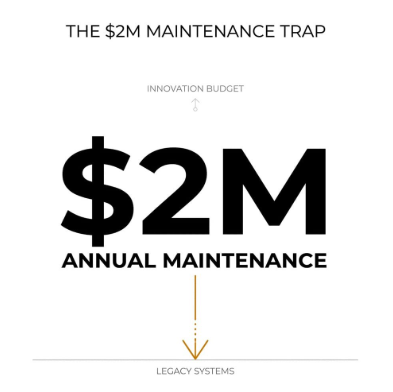
Nearly two-thirds of businesses now invest more than $2 million annually on maintaining and upgrading legacy systems. Not building new capabilities. Just keeping the lights on.
The Stakeholder Ripple Effect
Technology debt doesn’t stay contained in IT. It cascades through your entire organization.
Your CIO fights daily battles with legacy systems that cost more to maintain than replace. Your COO watches competitors move faster while your team drowns in manual processes. Your employees get frustrated with tools that feel like they’re from a different decade.
Your sales and marketing teams struggle with customer-facing technology that makes you look outdated. Your customers experience clunky digital interactions and start looking at competitors.
Someone usually sounds the alarm early. Often it’s your IT director who sees the writing on the wall. Sometimes it’s your COO who watches operational costs climb while efficiency drops. Occasionally it’s a sales leader who loses a deal because your competitor had a mobile app and you didn’t.
The warnings get ignored until they become a crisis.
Why? Because the cost of modernization feels immediate and concrete. The cost of staying on legacy systems feels abstract and distant. Until it doesn’t.

The Budget Paradox That’s Killing You
Here’s the paradox that traps most mid-market companies: Industry studies show that firms digitizing their processes can cut operational costs by 10-30%. Yet companies cite budget constraints as the main barrier to modernizing.
You’re avoiding the investment that would save you money because you’re worried about money.
The math gets worse the longer you wait. Technical debt costs organizations 23-42% of total IT budget through increased maintenance, reduced productivity, and missed opportunities. Each year of delay increases eventual modernization costs by 20-25%.
A system with $1 million in technical debt today will have $2 million in less than four years. The interest compounds faster than you think.
Meanwhile, you’re spending up to 40% of your IT budget just maintaining technical debt. By 2025, companies will spend 40% of their IT budgets on maintenance, with application costs making up to 80% of the entire IT budget.
That’s money you’re not spending on innovation, competitive advantage, or growth.
The Competitive Chasm That’s Widening Daily
The gap between digitally mature companies and those stuck in legacy infrastructure is accelerating.
Startups launch with cloud-native infrastructure. They don’t have technical debt because they never had legacy systems. They move faster, scale easier, and operate with lower overhead than established mid-market firms carrying decades of accumulated technology decisions.
Large corporations captured 69.20% of the United States digital transformation market share in 2025. They have deeper budgets and dedicated transformation teams. They’re pulling away.
You’re stuck in the middle. Too large to move with startup agility. Too small to match enterprise resources.
The technology gap creates a talent gap. Top performers want modern tools. When 76% of developers report that technical debt affects their morale and job satisfaction, you’re facing retention challenges on top of everything else.
Your best people leave for companies with better technology. You’re left with a smaller team managing more complex legacy systems.
The Sector-Specific Breakdown
This plays out differently across industries, but the pattern is consistent.
In professional services, mid-tier law firms lag in practice management technology. They see technology as both an opportunity and a threat. Many prefer to wait for evidence before investing in AI or modern practice management systems.
While they wait, their competitors implement. Clients expect digital portals, mobile access, and real-time updates. When you can’t deliver, they leave.
In manufacturing, the stakes are even higher. Unplanned downtime costs up to $260,000 per hour. In automotive manufacturing, downtime costs between $22,000 and $50,000 per minute. Mid-sized manufacturers slow to adopt Industry 4.0 principles watch these costs accumulate while competitors optimize.
The customer-facing impact hits hardest. 74% of customers expect more digital and personalized experiences by 2025. When you can’t deliver, 70% will abandon your brand after just two bad experiences.
You lose customers faster than you can replace them.
The Triggering Events That Force Action
Most mid-market companies don’t modernize proactively. They modernize reactively, after damage is already done.
The triggers are predictable:
- A major customer complains about your digital experience and threatens to leave
- A new competitor launches with an app or digital service you can’t match
- A legacy system fails or experiences an outage that exposes your vulnerability
- A CEO change brings a modernization mandate from leadership
By the time these triggers fire, you’re in crisis mode. You’re fixing problems under pressure instead of building capability from a position of strength.
The timeline and cost to fix technology debt in crisis mode versus proactively? The difference is staggering.
Proactive modernization lets you plan, budget, and execute in phases. You maintain business continuity while upgrading systems. You train teams gradually. You test thoroughly.
Crisis modernization means emergency spending, rushed implementations, and disrupted operations. You pay premium rates for urgent work. You accept higher risk because you have no choice.

The Point of No Return
There’s a moment when a mid-market company crosses from “behind but recoverable” to “too late to catch up.”
You reach permanent disadvantage when your technology debt becomes so severe that the cost to modernize exceeds your ability to fund it from operations. When your best customers have already left. When your top talent has moved to competitors. When new market entrants have captured the customers you should have won.
Without intervention, this gap will widen over the next one to three years as technology leaps in AI, automation, and cloud computing accelerate. Many mid-market firms will play catch-up throughout this period. Some will leapfrog through smart investments. Others will face permanent disadvantage.
The window is closing faster than you think.
The Path Forward Starts Today
You need to start now. Your data is only getting larger and more complex every day.
Day one looks like this: Your COO walks into the office tomorrow and has a specific conversation with your CIO and CFO. Not about buying software. About quantifying the actual cost of your current state.
Calculate how many hours your team spends on manual data entry each week. Multiply by hourly cost. Add the cost of errors and rework. Factor in the revenue you’re not capturing because you can’t scale without proportional headcount increases.
Put a real number on what staying on legacy systems is costing you right now.
Then map your critical business processes. Identify the three biggest bottlenecks created by legacy systems or manual workflows. Prioritize based on business impact, not technical complexity.
Start with one process. Modernize it completely. Measure the results. Use those results to fund the next modernization.
You don’t need an enterprise-level budget. You need to stop treating modernization as an all-or-nothing proposition.
The companies that survive the next three years won’t be the ones with the biggest IT budgets. They’ll be the ones who started today instead of waiting for perfect conditions that will never arrive.
Your competitors are already moving. Your customers are already expecting more. Your best employees are already looking at companies with better tools.
The question isn’t whether you can afford to modernize. The question is whether you can afford not to.